

It’s Monday morning in New York. Your engineering lead needs a senior data engineer to get a migration back on schedule. You have enough work for at least six months, and the team is already stretched. You’re open to hiring in India, but someone asks a question that stalls the conversation. Do we need to open an office there first?
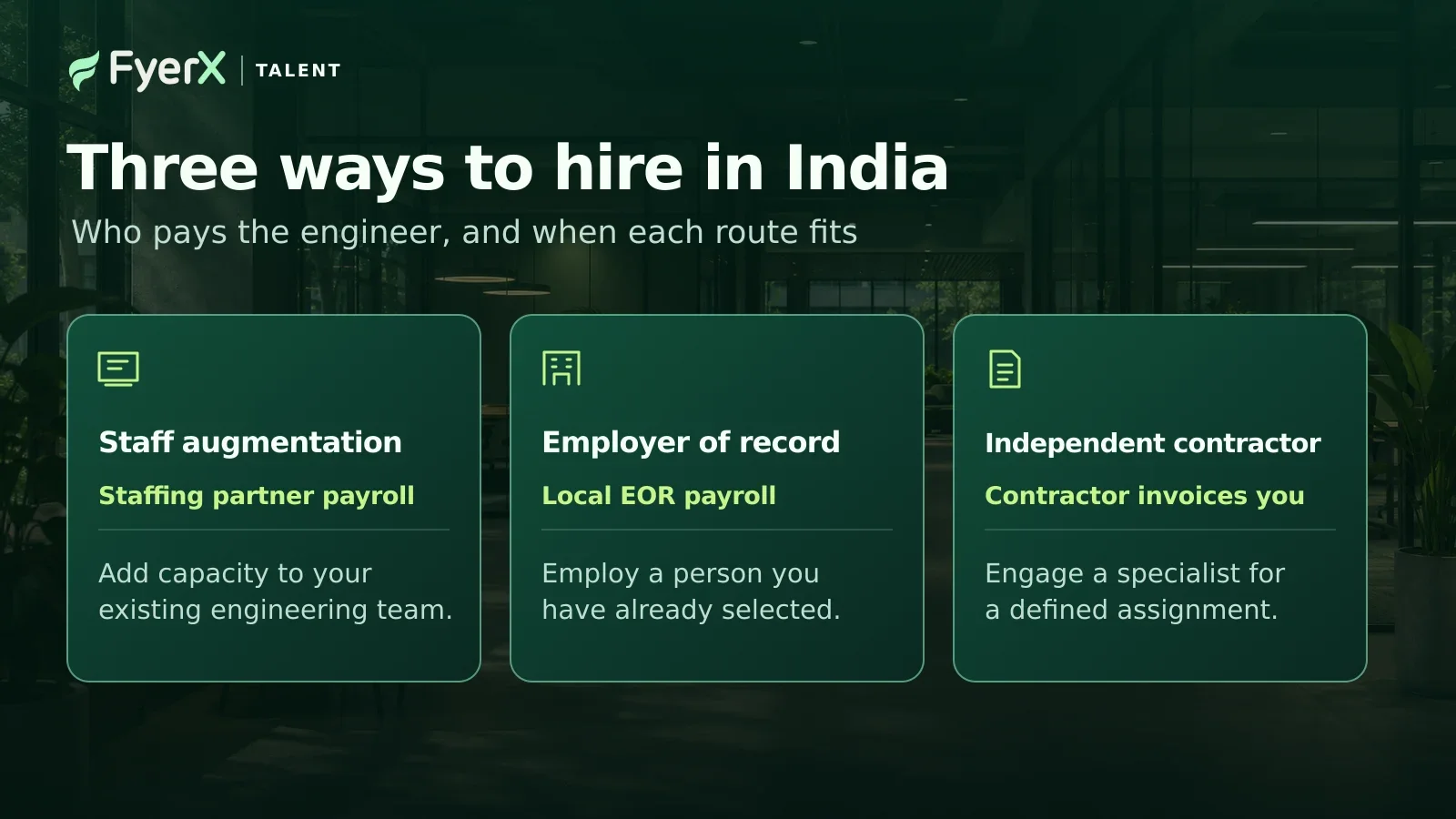
For many teams, the answer is no. A US tech company can bring India-based engineers onto a project through a staffing partner, use a local employer of record to employ a person it wants to hire, or engage a genuinely independent contractor for a defined piece of work. Those routes can all look the same on a Zoom call. They work differently when it’s time to pay someone, grant access to customer data or bring in a replacement.
In February 2026, Nasscom estimated that India’s technology sector would reach 5.95 million employees in its 2025–26 fiscal year. That broad figure gives you a sense of the market’s size. Your search still comes down to a much smaller question. Can you find someone who has done the kind of work you need, is available when the project starts and can work with your team’s schedule?
Three ways to hire engineers in India without opening a local office
1. Offshore IT staff augmentation
A staffing company sources and screens engineers for your project. In a typical arrangement where the engineer is on the Indian staffing partner’s payroll, you sign a services agreement with the partner and pay its invoices. The partner handles payroll and employment administration. Your engineering team runs the backlog, reviews code and decides what ships.
This can work well if you need one or two people to join an existing team for a release, migration or stretch of ongoing product work. Ask how the partner verifies relevant experience and availability before submitting a candidate. Then ask what happens if the engineer leaves halfway through the project. Get the proposed replacement window, handover terms and billing treatment in writing.
2. Employer of record in India
An employer of record, or EOR, employs the engineer locally and handles employment administration such as payroll and benefits under that arrangement. Your company typically selects the engineer and directs their day-to-day work. Recruiting may be a separate service, so check what the provider’s fee covers.
Say you’ve already interviewed an engineer you want to work with long term. An EOR can give you a way to employ that person through an Indian provider while your company decides whether it needs a local entity. The arrangement still needs a clear answer on equipment, IP ownership, notice and what happens if you later move the employee to a different employer.
3. Independent contractor in India
An independent contractor invoices for their services. This route may fit a specialist engagement with a clear scope, such as reviewing a database migration plan and delivering a report plus a test run.
A six-month role can look different in practice. If you plan to set the person’s working hours, supervise their daily work closely and treat them like the rest of your employees, have your advisers assess whether the contractor model fits. The way the work actually happens matters alongside the words in the agreement.
Before you sign, ask your legal and tax advisers to review the setup in both countries, including any potential taxable presence in India. The US–India tax treaty addresses when a business may have a permanent establishment, a tax concept separate from whether it has leased an office. Give your advisers the actual duties, reporting structure and authority the person will have so they can assess your facts.
What does an offshore engineer actually cost?
Suppose a staffing partner quotes $35 per hour for a data engineer. At 160 billable hours, the base invoice would be $5,600. That’s an illustrative quote. The number you use for planning depends on what the agreement treats as billable.
Does that invoice include the laptop? If your release slips and you need weekend work, does a different rate apply? Who absorbs the cost of a replacement’s handover? Also budget for the time your own lead will spend reviewing work and answering questions. Those hours may never appear on a vendor invoice, but they come out of the same sprint.
When you compare quotes, give both partners the same role, hours, equipment needs and start date. Ask each for a sample invoice for an ordinary month and for the first month. You’ll see whether setup, recruiting or other one-time costs change the comparison.
What US–India working hours look like in practice
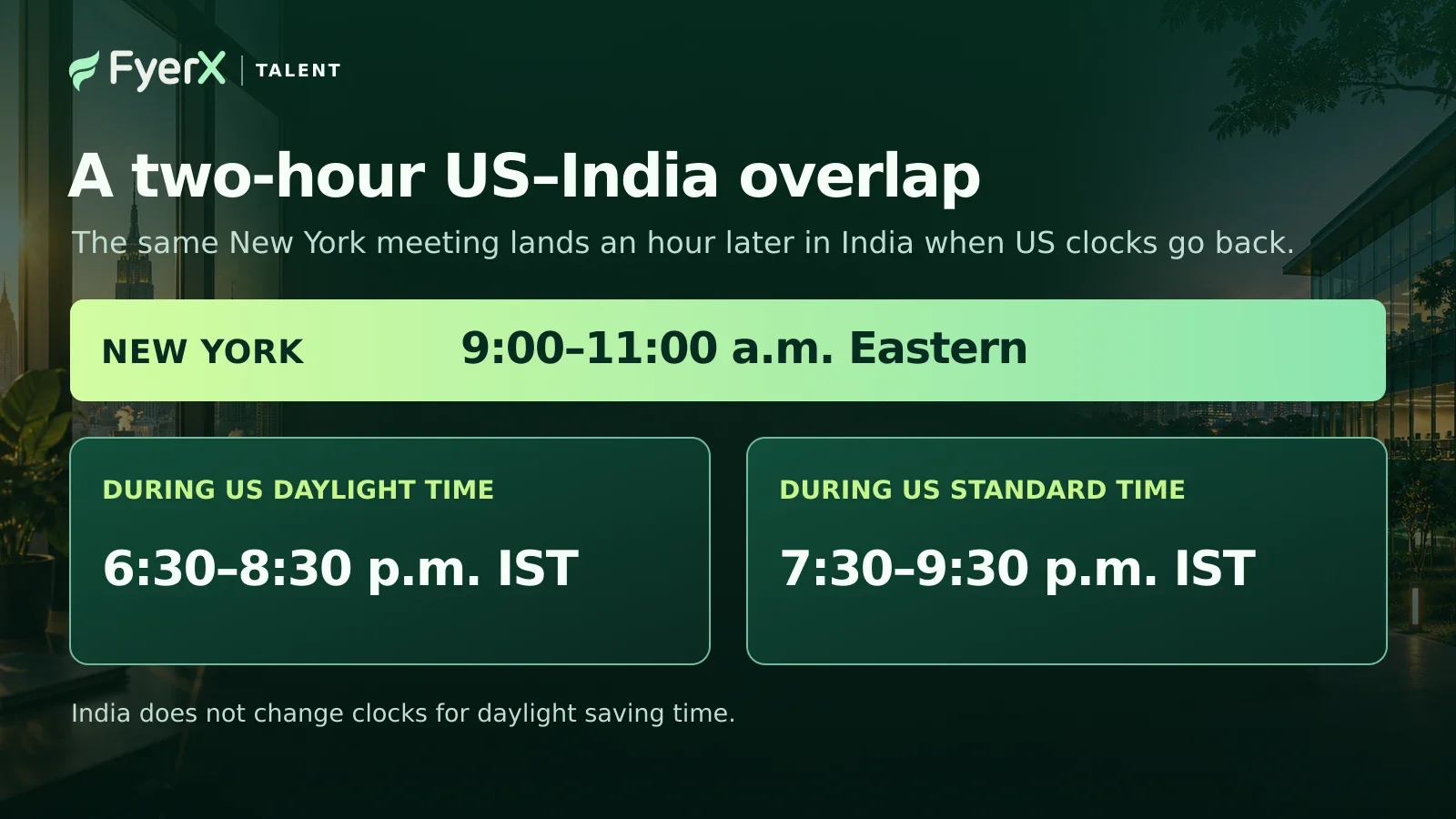
Say your New York team sets aside 9 to 11 a.m. Eastern for live collaboration. In India, that’s 6:30 to 8:30 p.m. during US Eastern daylight time and 7:30 to 9:30 p.m. during US Eastern standard time. India’s clocks stay on the same time year-round, so a meeting that felt manageable in July may be late in November.
Use overlap for conversations that genuinely benefit from having everyone there, such as a design decision, a blocker or a release handoff. Leave routine updates in the ticket, and make sure pull requests have enough context for someone in another time zone to review them. Confirm the normal working hours and any on-call expectations with the staffing partner and the engineer before the start date. If your leads sit in California, run the numbers for Pacific Time as well.
What to put in the very first staffing brief
Picture two requests. The first says “senior data engineer, Python, AWS.” The second says “migrate three production data pipelines to Airflow, own rollback planning, and work with our New York lead for two hours a day.” The second gives a recruiter a way to test whether a candidate has done the work.
Four details make that brief easier to use.
The first outcome. Write down what the engineer should deliver in the first month, such as migrating one lower-risk pipeline and documenting how to roll it back.
The experience that matters. Ask candidates to describe a pipeline migration they owned, including how they checked that the old and new pipelines produced the same results.
The practical terms. Confirm the target start date, expected duration, budget, reporting lead and live overlap. Ask the staffing partner to check those with each candidate before you schedule interviews.
Who owns the first week. Assign an internal lead for access, code review and approvals. Agree on how equipment, credentials and customer data will be handled.
Give the recruiter a short brief they can use on a real call. When a profile arrives, you should know what the candidate actually worked on, when they can start and which open questions need an engineer’s judgment. Résumé keywords alone won’t tell you any of that.
Start with one engineer and a clear first assignment
Back to the migration. A practical first step would be to bring in one engineer with migration experience, a named manager and a defined first assignment. Use week one to get access in place, walk through the pipeline and agree how to test the change. By the end of the first month, review the output, the quality of the handoffs and whether the time-zone overlap worked for both teams. That gives you evidence for deciding whether to add another person.

FyerX Talent helps US-facing teams scope offshore IT staffing requirements and source India-based engineers for roles in areas such as data, cloud, DevOps and enterprise platforms. We can turn your project brief into screening criteria and work through availability, collaboration hours and onboarding expectations before the search begins.
Need an India-based engineer for your US team? Talk to FyerX Talent about the role, start date and work you need delivered.
Looking for recruitment support?
Tell us which roles you’re hiring for and when you need them filled.
Talk to FyerX Talent