

On Friday, you were fixing a deployment. On Monday, your calendar is empty. By Tuesday, you’ve applied for three jobs you’d want and fifteen you barely remember opening. A former colleague messages, “Send me your CV.” You open the file and realise it still lists the project you left two years ago.
The first month after an IT layoff can feel like an emergency. Give it a plan you can work through. Get your exit paperwork in order, pick two roles you can make a strong case for, and build a routine that gets you from applications to conversations. Thirty days gives you a point to review how the search is going. Employers set their own interview and offer timelines.
There are still openings worth looking for. Staffing firm Xpheno’s November 2026 outlook tracked 1.3 lakh active tech job openings in India, including 97,000 full-time roles. That’s advertised demand in one market snapshot. Your best lead is a vacancy whose requirements match something you’ve already delivered.
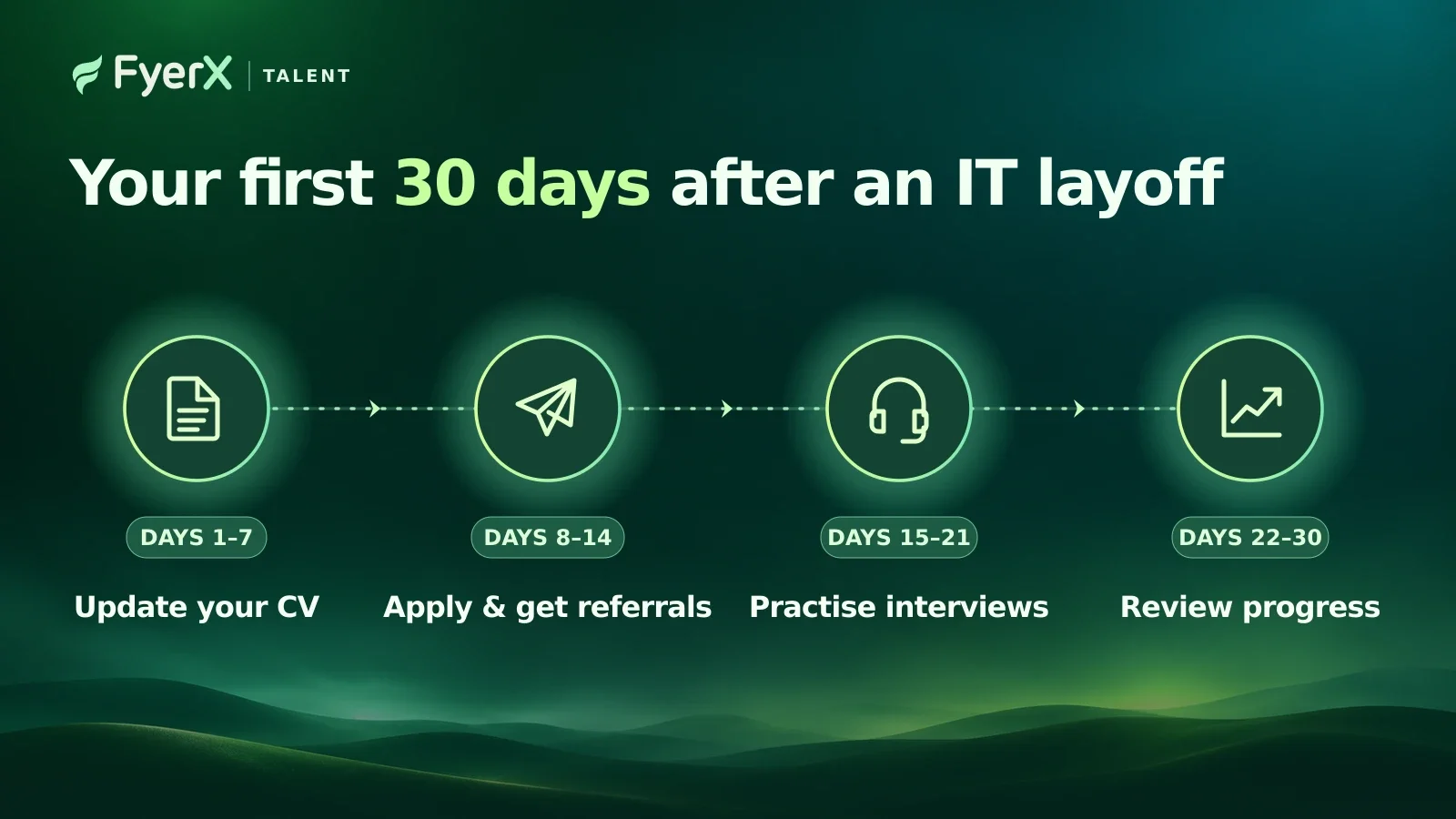
Days 1–7. Get your documents and CV ready
Work out when you can join
Ask HR to confirm your last working day, the dates they’ll use for employment verification, and when to expect your final settlement and experience or relieving letter, if applicable. Save the personal records your employer permits you to keep, such as payslips and separation correspondence. Leave client files, code and other company materials with the employer.
Tell recruiters the earliest start date you can actually commit to. If you’re still employed through a transition period, give your confirmed release date. If you’ve left and are available immediately, say so on your Naukri profile and on recruiter calls. Have the same employment dates on your CV, LinkedIn and application forms.
Pick two job titles and show what you’ve done
Choose one role close to your last job and one adjacent role you can support with real experience. A QA engineer who has automated API tests might look at QA Automation Engineer and Software Development Engineer in Test (SDET) openings. A manual tester with no automation work could start with QA roles that value exploratory testing and add a small automation project to show progress.
Pull up ten relevant job descriptions. Note the responsibilities that repeat, then move the work that proves you can do them to the top of your CV. “Worked on regression testing” tells a recruiter little. “Built API regression tests in Postman for the payment flow and ran them before each release” tells them what you did, where you did it and why it mattered. If you have a reliable result you can share, add it.
Days 8–14. Start a targeted job search after the layoff
Your old teammate can probably remember that you were good at your job. They may have no idea which title to look for or where you can work. Make it easy for them to help. Send a specific role or a short note they could forward to someone who’s hiring.
Hi Priya, I’m looking for QA Automation or SDET roles in Bengaluru or remote. My recent work was in API testing and regression automation with Postman and Java. I’m available from 7 December. If you know a team hiring for similar work, I’d appreciate an introduction. Happy to send my CV and the job link.
Adapt the date, location and skills to your situation. Reach out to former managers, teammates and recruiters who already know your work. Alongside referrals, apply on company career pages or job boards when the role matches your skills, experience and work location. Check whether a recruiter has already submitted you for the same opening before agreeing to another submission.
Give yourself a manageable weekly target. Ten well-matched applications and five outreach messages are one way to start. Keep a simple tracker with the role, source, application date, next step and outcome. The point is to learn where genuine conversations are coming from.
Days 15–21. Practise how to explain the layoff in an interview
Prepare a short answer to “Why did you leave?”
Give the reason you can verify and move on to the work you’re equipped to do next. If your job ended in a restructuring, you can keep the answer this simple.
My role was affected by a restructuring. On my last project, I built and maintained API regression tests for our payments releases. I’m now looking for a QA automation role where I can take more ownership of release quality.
Use “restructuring” only if that reflects what happened. Keep the answer consistent with your employment dates and what your former employer can confirm. You can acknowledge a difficult exit in one sentence and spend the rest of the conversation showing what you can do.

Rehearse two stories and one technical task
Prepare a story about something you delivered and one about a problem you owned when things went wrong. Use STAR to structure each answer. Describe the situation and your task briefly, then spend most of the answer on what you did and what happened. Amazon uses this framework in its interview guidance.
Then ask a former colleague for a 30-minute mock interview. Pick a task that resembles the work you’re targeting. If you’re a QA engineer, walk through how you’d test an API that handles failed payments. Explain what you’d check first, what an acceptable result looks like and where you’d need more information. Use public or dummy data if you bring a demo.
Days 22–30. Work out where your job search is stalling
Open your tracker. Imagine you’ve applied for 20 roles, had four recruiter calls and reached zero technical rounds. The last four conversations may tell you more than the 20 applications. What caused the calls to stop? Was it the required experience, location, salary range or the way you explained your work? Ask for feedback where you can, and change one thing before applying to the next set of roles.
Few recruiter calls. Compare the top third of your CV against five recent vacancies. Check whether the target job title, core skills and relevant work are easy to find. Ask a former teammate to review it against one live job description.
Recruiter calls with few interview invitations. Check whether the role’s seniority, work location and start date fit before the call ends. Practise explaining one project in a minute, including the part you personally handled.
Interviews with few next rounds. Write down the questions you struggled with as soon as each call ends. If you keep getting stuck on SQL joins or debugging an API failure, use your next practice session to solve that specific problem aloud.
If you’re considering a contract opening, ask who employs and pays you, how long the project is expected to last, and what the written terms say about a possible move to permanent employment. Assess the offer based on the work and terms you have in writing.
What a good Day 30 can look like
You might have an interview lined up. You might have heard back from two former colleagues and discovered that one job title gets much better responses than the other. Both give you something concrete to act on. Hiring teams can take longer than a month to make a decision, so measure the progress you can see in your own search.
One hiring decision ended your last role. You still have the skills you used to build releases, fix incidents and get projects over the line. Pick one role that fits that experience today. Write down the strongest example you’d give in its interview, then send the job link to someone who knows your work. You’ll have made the next application count.
Looking for your next IT role? Choose I’m Looking for a Job on the FyerX contact page.
Looking for recruitment support?
Tell us which roles you’re hiring for and when you need them filled.
Talk to FyerX Talent