

Your US engineering director has six months to move twelve applications to the cloud. The budget covers five engineers in India. Procurement needs a brief by Friday, and the director has a choice. Should she ask recruiters for five specialists, or ask a staffing partner for a team with its own technical lead?
Imagine what happens in week three. The migration engineer is ready to test an application, but the cloud environment is missing a network rule. The person who can approve it is in the US and starts work several hours later. The database engineer moves to another task. A test window closes. Five people were available, yet the application didn’t move.
A team lead in India could spot that dependency earlier and arrange the approval. A US engineering lead could do the same if they had time to run the migration day to day. That’s the hiring decision hiding inside the headcount request. Who is going to join the pieces of work together?
What changes when you hire a team instead of five individual engineers?
With individual staff augmentation, you hire against specific skill gaps. You might bring in a platform engineer for your cloud team, an application engineer for a product squad and a database engineer for your data team. The five people can all come through the same staffing partner. Your managers own their priorities and work out when those priorities overlap.
A coordinated team, sometimes called a staffing pod, is built around a shared workstream. It has a named lead who sequences the work and escalates blockers. In our example, that lead coordinates readiness across applications, gets the right people into cutover planning and reports progress to a US sponsor. The US company still decides who can access production and who can approve a release.
A third option is a managed delivery agreement, where the supplier commits to defined outcomes under an agreed scope and acceptance criteria. A five-person staffing team with a lead may still be billed as staff augmentation. If a proposal says “managed team,” ask what the supplier commits to delivering and what happens if the agreed work slips. A technical lead and a delivery commitment should each be explicit in the agreement.
What would a five-person cloud migration team actually look like?
Start with the work you’re moving. Twelve applications with shared databases, complicated integrations and strict downtime limits call for different skills from twelve standalone internal tools. AWS’s large migration guidance says to plan waves around factors such as application complexity, similarities and dependencies. That’s useful before you hire. If several applications rely on the same database or identity service, the person who can untangle that dependency may be one of your first hires.
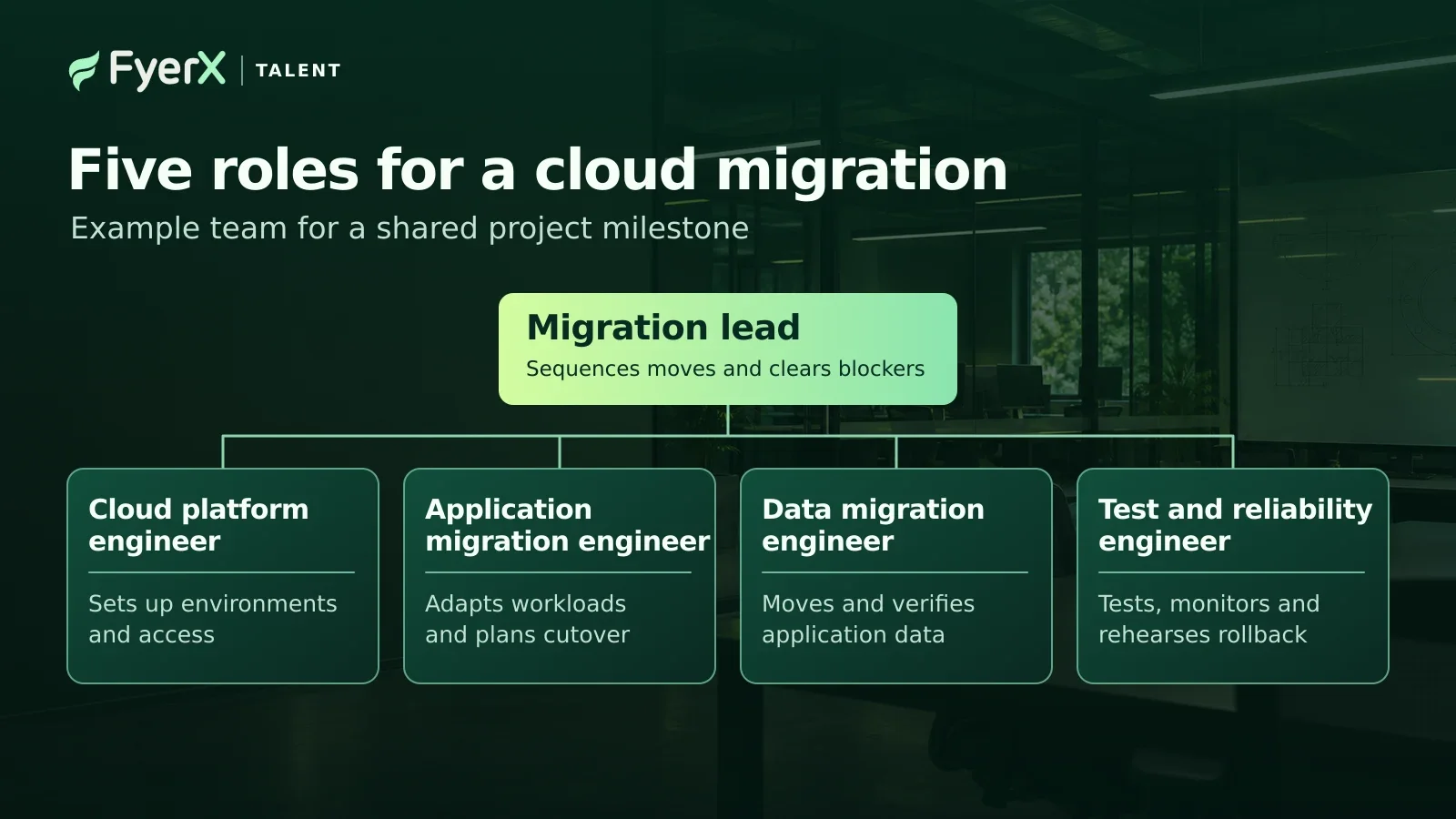
Here’s one way to divide the work for this migration.
Migration lead. Proposes the order of moves, owns the readiness review and brings decisions to the US sponsor.
Cloud platform engineer. Sets up the target environments, networking, access controls and deployment automation.
Application migration engineer. Adapts each application to run in its target environment and works with application owners on cutover.
Data migration engineer. Plans database moves and checks that source and target data match after the move.
Test and reliability engineer. Verifies critical workflows, checks monitoring and helps rehearse the rollback.
The five roles describe what this project needs covered. On another project, one engineer could cover platform and reliability while a second application specialist handles more of the code changes. If your internal security team owns cloud access, name its approver in the staffing brief and book time for that person before the pilot starts.
When five individual hires are the better choice
Choose individual hires when your existing teams already know what to do and have the leaders to manage it. Maybe your platform team needs someone to automate deployments, while two product teams each need a backend engineer for separate releases. Those jobs can move independently. Each new engineer can slot into a backlog with an owner who knows the codebase and can review their work.
This model also gives you more flexibility on timing. You can hire the database engineer now and add a testing specialist when there is enough to test. It’s especially useful if you want to choose each person through your own interview process and give them a long-term home on an existing team.
A coordinated team is worth considering when the five people are working toward the same milestone, their tasks depend on one another, and your US lead has limited time to coordinate them. Ask to interview the proposed team lead first. Give that person a real example from the project and ask how they’d sequence the moves, who they would involve and when they would stop a cutover. Ask whether the proposed engineers have worked together before. If the team is being assembled for your project, find out who will run its first week and how the vendor will cover a role that starts late.
What are you paying for when one of the five is a lead?
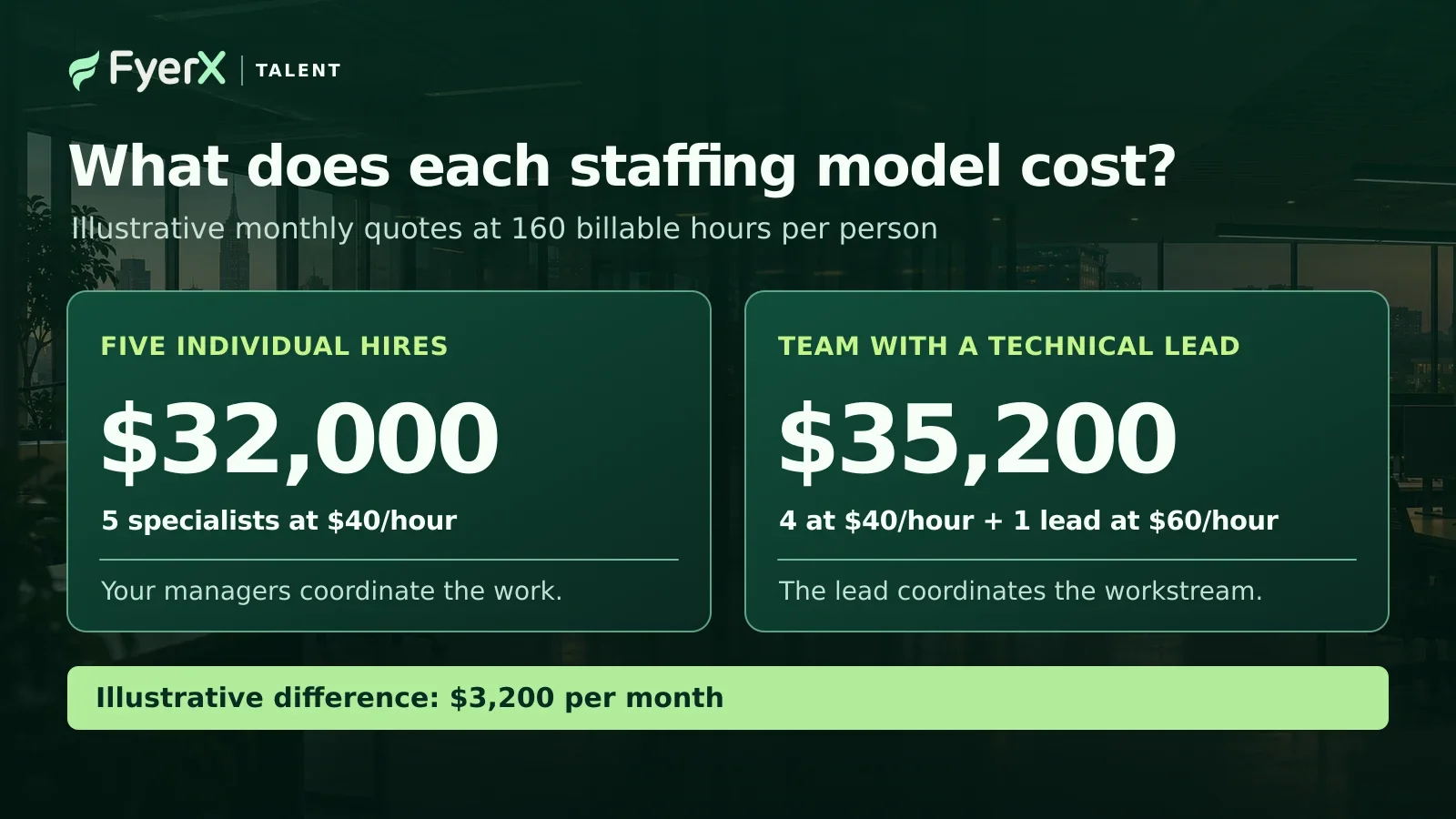
Take two illustrative quotes at 160 billable hours per person per month. Five specialists at $40 per hour each would cost $32,000. Four specialists at $40 per hour plus a lead at $60 per hour would cost $35,200. The difference is $3,200 a month at those assumed rates and hours.
Now compare what you’re asking each group to do. In the first quote, five specialists can spend their time on implementation while your managers handle coordination. In the second, part of the team’s capacity goes toward planning waves, arranging approvals and keeping the other four engineers moving. Ask how much hands-on work the lead is expected to do and what progress reporting you’ll receive.
Before comparing the totals, align the quotes on working-hour overlap, cutover and on-call coverage, equipment and replacement handovers. Check whether the hours are billed as used or committed every month. If a vendor is quoting for a completed outcome, ask for the scope, acceptance criteria and how it handles changes. That gives you a basis for comparing it with a monthly staffing quote.
Start with one migration wave before you commit to all five
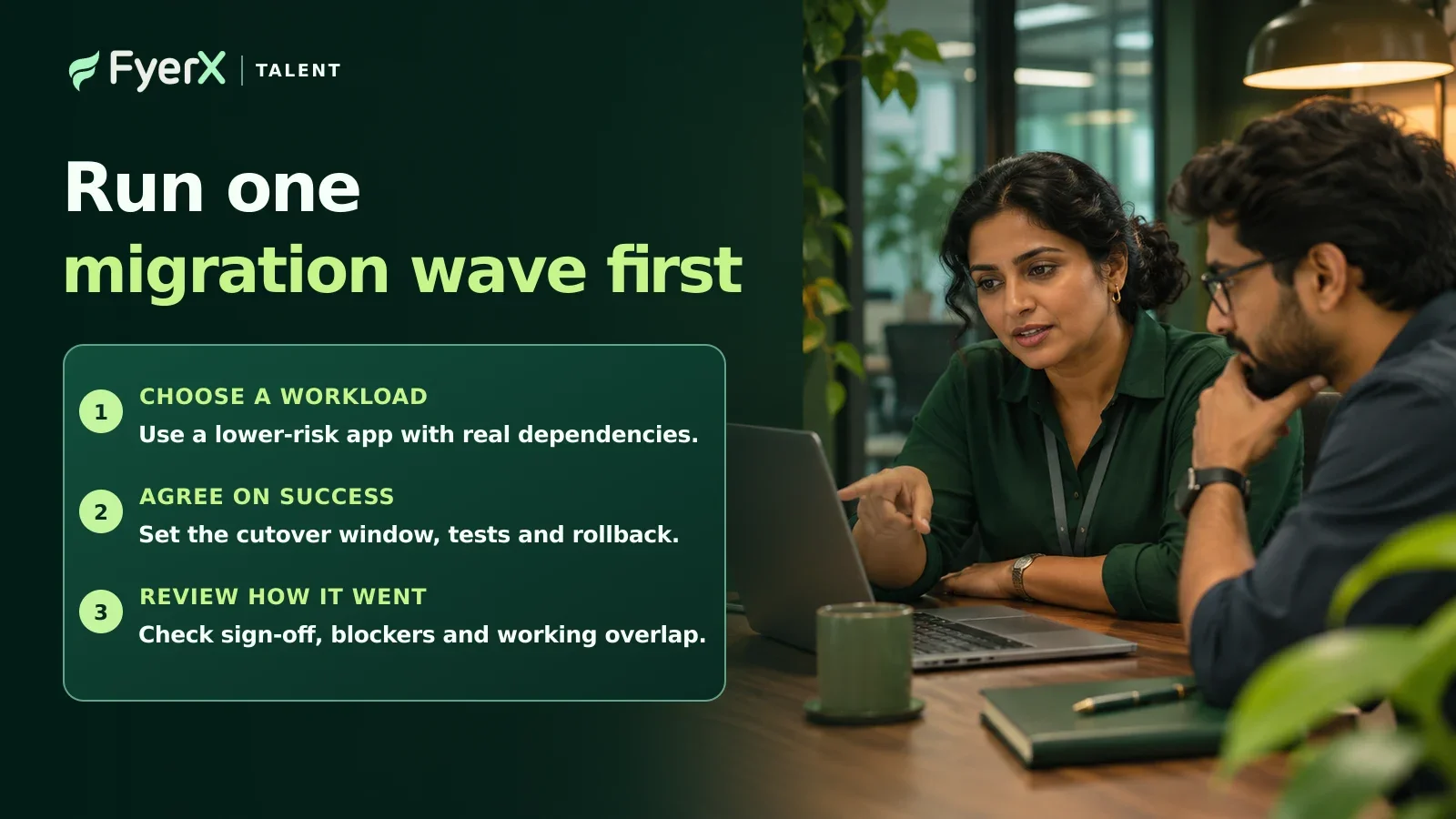
Pick a lower-risk application that still has meaningful dependencies. Identify who owns it, what must be true before it moves and how the team will decide whether to roll back. Agree on what a successful pilot looks like, such as completing the move within the planned window, passing agreed smoke tests and getting sign-off from the application owner.
Then check how the people worked together. Did the team raise blockers early enough for the US sponsor to act? Could the application owner tell what had changed? Did the working-hour overlap cover the approvals the team actually needed? Depending on the pilot, you might start with the lead and two specialists and bring in the rest when there’s enough work ready.
If your existing managers can run the project and each engineer has a distinct backlog, fill the roles individually. If the work depends on five people moving through the same sequence and no one on your side can manage that daily, put a named lead in the staffing brief. The first migration wave will give you a better basis for the next staffing decision than any headcount plan on its own.
FyerX Talent helps US-facing teams source individual engineers in India and build staffing pods around a defined project phase. We work with your delivery lead to map the roles, screen for relevant project experience and coordinate interviews and onboarding across the team.
Need five engineers in India? Talk to FyerX Talent about the work, the start dates and who needs to lead delivery.
Looking for recruitment support?
Tell us which roles you’re hiring for and when you need them filled.
Talk to FyerX Talent