

The recruiter likes your experience. The role is close to what you want. You’ve even agreed on the salary range. Then comes the question that changes the call.
“How soon can you join?”
You say 90 days. The recruiter says the client needs someone in a month. Ten minutes later, you’re looking at your resignation letter and wondering if you need to send it just to get an interview.
You can start a job search, interview and accept a written offer while you’re still employed. A 90-day notice period can rule you out of an urgent opening, so find out which employers can work with your full timeline. Once you have an offer whose terms and joining date you can meet, you can resign and explore an earlier release.
Why recruiters ask about your notice period before an interview
Imagine a team needs an SAP consultant for a go-live in six weeks. A candidate who can join in 90 days will arrive after the work they were hired to help with. Another team might be hiring an SAP consultant for an implementation planned for the next quarter. The job titles could be identical. The date decides whether either conversation goes anywhere.
Recruiters can make that decision before calling you. Naukri’s Resdex recruiter guide lists notice period as a filter that recruiters can apply to candidate searches. A profile can fit the technical requirements and still fall outside a search narrowed by availability. Naukri Resdex guide
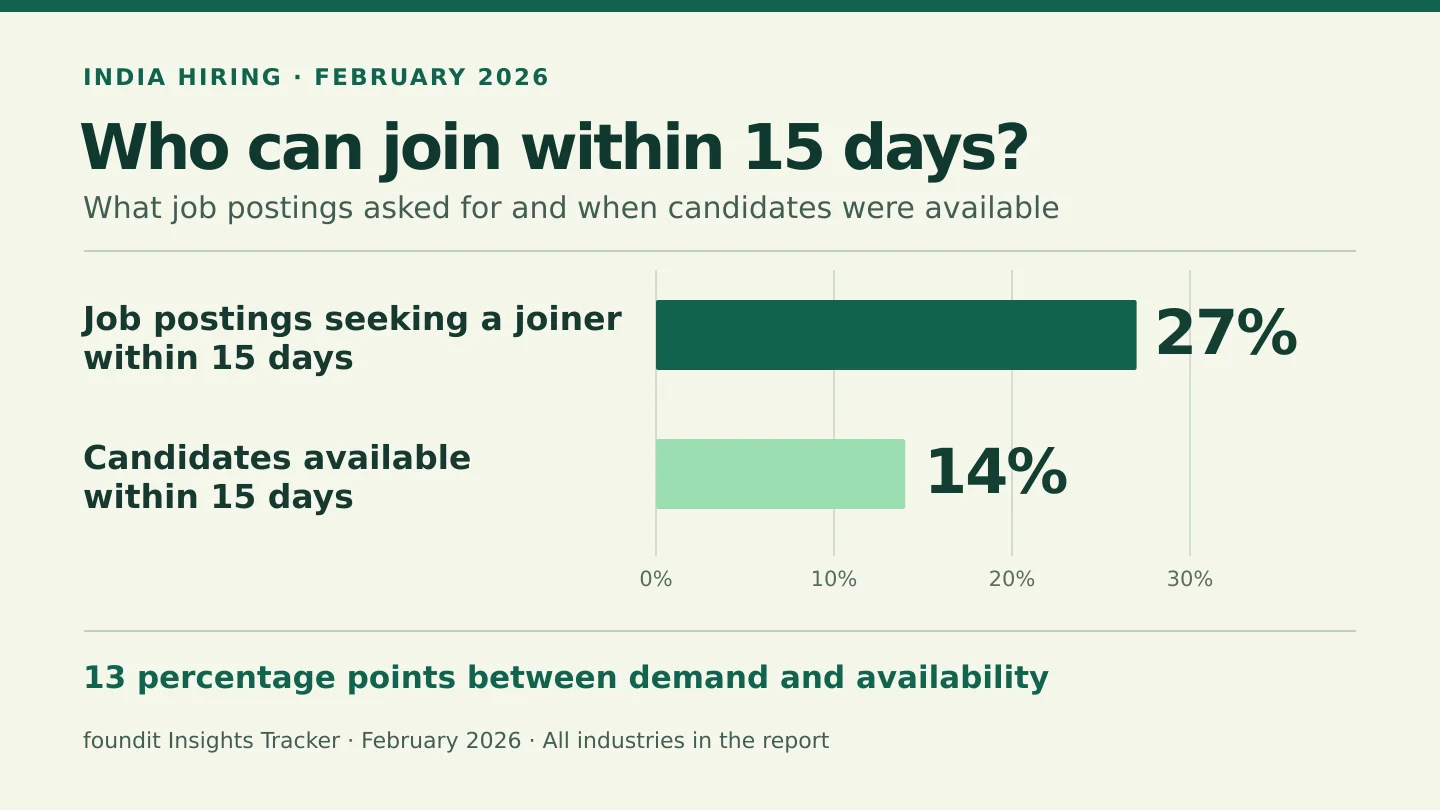
In foundit’s February 2026 hiring tracker, 27% of job postings sought candidates who could join within 15 days, while 14% of the talent pool was available that quickly. The same analysis showed 17% of employer demand in its 60–90-day category. These are figures from foundit’s analysis across industries. Ask the recruiter for the actual start date for the IT vacancy you’re discussing. foundit Insights Tracker, February 2026
How to switch jobs with a 90-day notice period
1. Check the date you can realistically offer
Read the resignation clause in your appointment letter and the current exit policy. Check when your notice begins, how the company counts the days, and whether there is a process for early release, leave adjustment or notice pay. Make a note of any handover requirements. A colleague who left in 45 days last year may have had a different manager, project or policy.
If you’re still employed and haven’t resigned, say “90 days from resignation.” If you’re already serving notice, share the last working date your employer has confirmed, if available, and the earliest date you can actually start. Update your Naukri profile when your availability changes.
2. Ask the recruiter for the latest acceptable start date
“Immediate joiner preferred” is a reason to ask a question. “Must join by 5 January” gives you a deadline to work with. You can ask this before agreeing to three technical rounds.
“The role looks like a good fit. My contractual notice is 90 days from resignation. What’s the latest date the hiring team can accommodate?”
If the role has a hard deadline you can’t meet, ask if that recruiter handles similar openings with longer lead times. A permanent hire for a team expansion, a new implementation or an upcoming programme can be worth looking at. Confirm timing for each role, even when a job description leaves it open.
3. Give the recruiter a reason to take your profile forward
Make it easy for someone to explain to the hiring manager why you’re worth waiting for. If you’re a ServiceNow developer, for example, name the modules you’ve implemented and one problem you solved. “Five years in ServiceNow, including an ITSM rollout and an integration that removed manual ticket creation” gives the recruiter something useful to pass on.
Here’s a short message you can adapt for a referral or a direct application.
“Hi, I’m interested in the ServiceNow ITSM role. I have five years of experience, including an ITSM implementation and REST integrations. My contractual notice is 90 days. If that fits the team’s hiring timeline, I’d be happy to discuss the projects I’ve worked on.”
How to reduce a 90-day notice period after an offer

Start with a handover plan. Your manager has to work out who will own your open tickets, speak to the client and handle the next release. List each responsibility, suggest who can take it over and give a date for the walkthrough. Then ask whether an earlier last working day is possible. That gives your manager something concrete to take to HR.
You can also ask about a notice period buyout, which uses payment in place of serving part of the notice. Whether you can exercise that option depends on how your contract is written and the rules that apply to you. If your employer offers it, ask which days it covers, how the amount is calculated and how the exit date will be recorded. If the new employer offers to reimburse it, get the amount and payment terms in writing. JSA Employment Newsletter on notice period buyouts
Say your contract calls for 90 days and the new company hopes you can start after 60. You might be able to complete the handover in 60 days and request an approved release for the remaining 30. You might also be asked to serve the full period. Here’s how you could put it to the recruiter.
“I can commit to 90 days. I’ll request a 60-day release and let you know as soon as I have confirmation. Can we put the 90-day timeline in the offer and bring the date forward if the release is approved?”
When should you actually resign?
Wait until you’ve reviewed the written offer and the new employer has agreed in writing to a start date you can meet. Check the role, fixed and variable pay, work location and any conditions such as background verification or client approval. If a recruiter says, “We’ll send the offer once you resign,” ask when you can expect the written terms and what approvals are still pending.
After submitting your resignation, get your last working day confirmed and update the new employer. Ask what documents they’ll need for onboarding and when your current employer expects to issue them. If the release date changes, tell the recruiter early so they have time to adjust the start date.
Common questions about 90-day notice periods
Can I put 30 days on Naukri if my notice period is negotiable?
Use the 90-day figure until you have a shorter timeline confirmed. On a call, you can explain there may be room for an early release and say what would need to happen. If the role works only with a 30-day start, both sides can make that decision early.
Can I start interviewing before I resign?
Yes. Use the first call to check the start date and the interview process. Bring your notice period up early so the recruiter can plan the offer and joining date if you’re selected.
What if every recruiter I speak to wants an immediate joiner?
Look at which roles you’re pursuing. If most ads are for urgent backfills or projects already underway, add roles with planned start dates to your search. Ask for referrals to teams hiring ahead of a new project and record the required joining date alongside each application. After a few weeks, you’ll see which applications are worth following up on.
A 90-day notice period changes your search. You can still start today.
Some jobs will close before you can join. A few will be worth a conversation precisely because the team has time to hire for the right skills. Your next move is to find out which kind of opening you’re looking at. Check your contract, tell the recruiter what you can commit to, and keep doing good work where you are while the search runs. When the right written offer comes through, you can hand over your current role with a joining date both employers can work with.
Exploring your next role in IT? Use the I’m Looking for a Job option on the FyerX contact page.
Looking for recruitment support?
Tell us which roles you’re hiring for and when you need them filled.
Talk to FyerX Talent