
You’ve waited all week for the price to drop on a phone. The Big Billion Days sale opens, you add it to your cart and tap Pay. The screen spins. Now you’re wondering whether to try again, whether your money went through, and whether the offer will still be there when the app catches up.
That’s the moment Flipkart’s engineers have to prepare for. In the opening hour of Big Billion Days 2026, Flipkart reported 6.3 million concurrent users in a single minute. At that scale, a slow service can turn an ordinary checkout into a question customers have to call support to answer.
One way Flipkart prepares is by deliberately creating failures in controlled tests and watching what happens. The practice is called chaos engineering. The name sounds dramatic. A good drill starts with a particular failure, a clear expectation and a team that knows exactly what it needs to learn.
Why a traffic test and a failure drill answer different questions
A load test asks whether the site can handle a surge in traffic. It might tell you if search stays responsive or if checkout slows as more shoppers arrive. A chaos experiment asks what happens when part of that system stops behaving as expected. Both questions matter when the sale goes live.
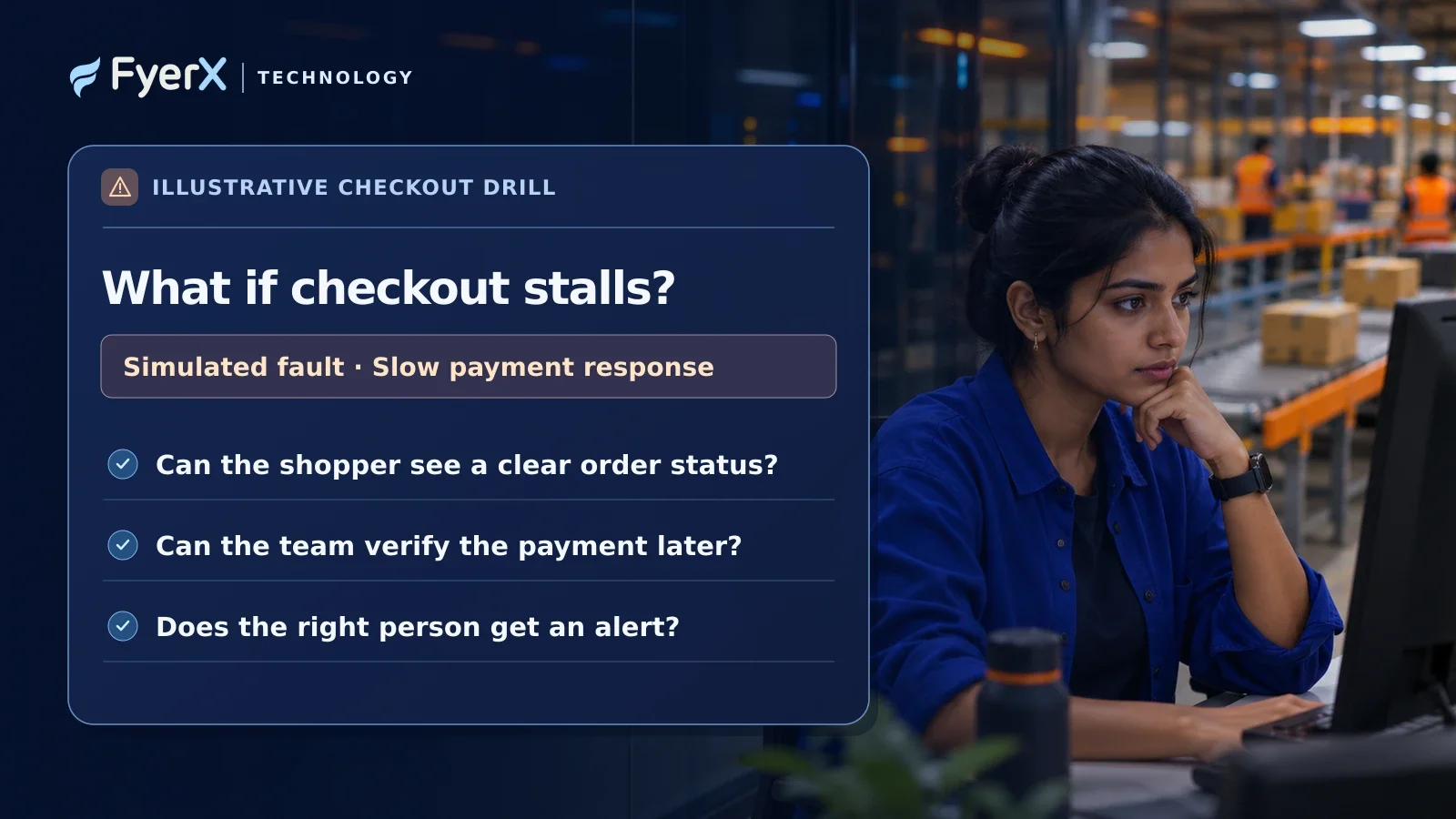
Picture a checkout drill for a fictional retailer. The team deliberately makes a dependency respond late in a test environment and follows a test order through the app. The order page should display a status the customer can understand. If the final payment result is still unknown, the team should be able to look it up and reconcile it with the order later. The people on call should get an alert that helps them find the cause.
That’s a more demanding test than checking whether the checkout page loads. A page can open while the service behind its Pay button is waiting for a response. The drill lets the team see the experience the shopper would actually have.
How Flipkart uses Kubernetes and LitmusChaos
Flipkart runs hundreds of interconnected services, according to the Cloud Native Computing Foundation’s June 2026 case study. Some run on Kubernetes, which manages how software containers are deployed and run. Others run on virtual machines. A sale can put both environments under pressure, even when a customer only sees one screen.
The Central Reliability Engineering team chose LitmusChaos, an open-source tool for running controlled failure experiments, and built a shared platform around it. Think of LitmusChaos as the tool that coordinates the drill, and Kubernetes as one of the environments where Flipkart tests its applications. The team extended the platform to cover its virtual machine workloads too, so both groups could use the same experiment history and dashboards.
The central team operates the platform. Individual teams can run experiments in the areas they own. In Kubernetes, those areas are often organised into namespaces, which group resources. This setup limits where each team can run drills while letting them reuse experiment templates from an internal library. CNCF’s 2026 award announcement said Flipkart ran approximately 90% of its chaos experiments in staging, a separate environment used to test software and changes before they reach customers.
The platform also lets teams test failures that depend on the state of the system. CNCF describes a database example where a drill first identifies which instance is currently coordinating writes, then checks whether another instance takes over when the coordinator becomes unavailable. That distinction matters. The results from an idle replica say little about what customers might experience if the instance doing the work stops responding.
What the engineers check during a failure drill
A useful drill starts with a statement the team can check. “If this service becomes slow, the order page should show an accurate status and the on-call team should get an alert.” That gives everyone a clearer goal than “see if the site stays up.”
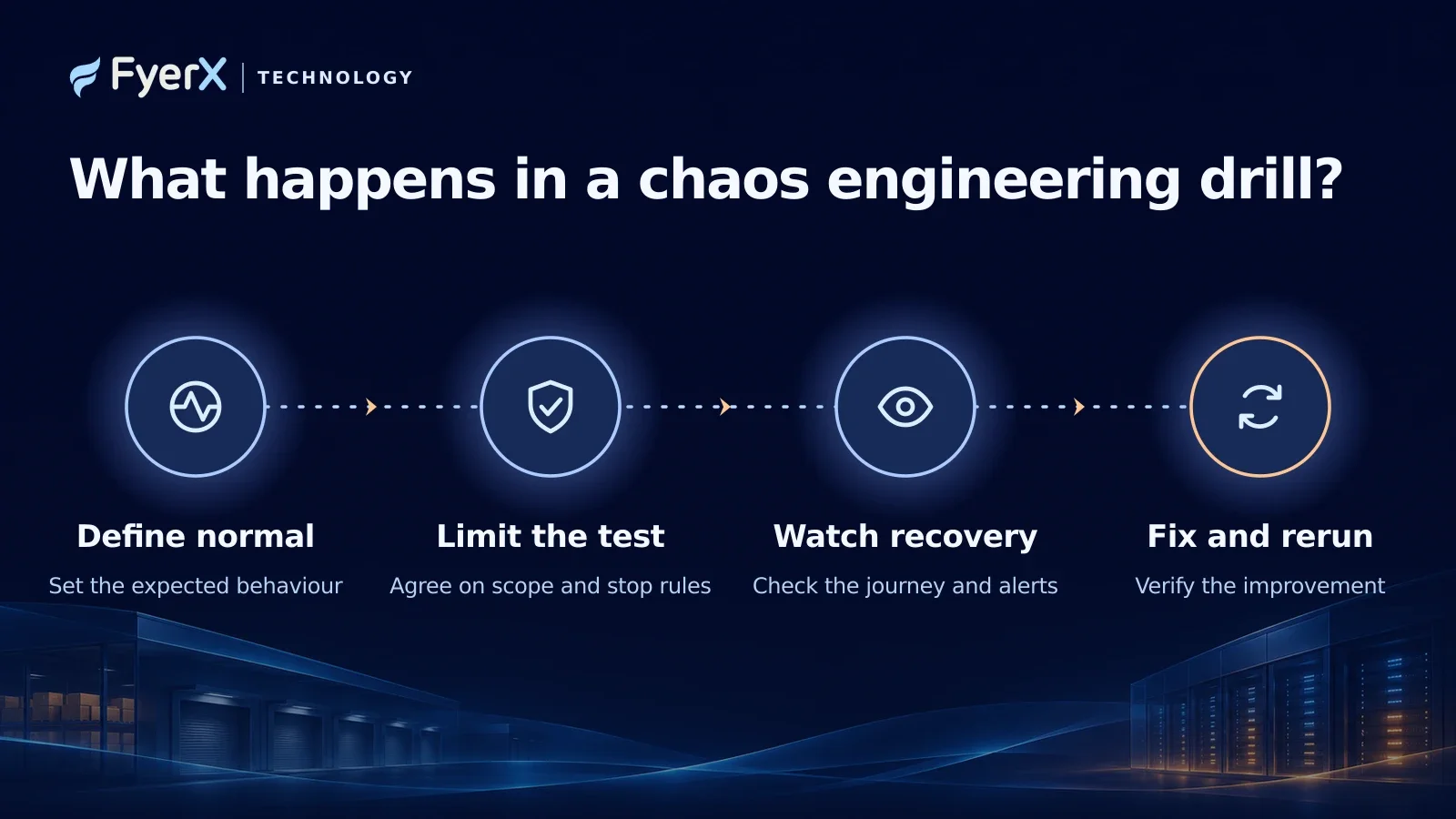
Define normal. Agree on what customers should be able to do and what the monitoring dashboard should show before the test starts.
Limit the experiment. Pick a failure, a test environment and the part of the system it can affect. Agree on when to stop and who can stop it.
Watch how the system responds. Follow the customer journey, monitor delays and errors, and see whether alerts reach the right people. Check how long the system takes to recover.
Fix what surfaced and test again. A broken alert is a finding. So is a recovery step that takes longer than the team expected. Update the system or the incident instructions and rerun the drill.
Flipkart’s published case includes examples of what this looks like. In one kind of drill, the team confirmed that heavy CPU use triggered the expected alerts. In another, network failures showed up as an increase in 5xx responses, the codes servers return when they hit internal errors or can’t complete a request. A useful alert reaches a person who can act on it while the problem is still small.
The test platform itself also had a weakness. In crowded staging environments, the temporary software that helped run some experiments couldn’t always start. That made it difficult to tell whether the application had a problem or whether the drill had failed to run. Flipkart changed how the helpers were deployed so they were already available when needed. CNCF reported that failures from that scheduling problem dropped from more than 10% of staging experiment runs to near zero after the change. A test can only tell you something if you know it actually ran.
What Flipkart found before Big Billion Days
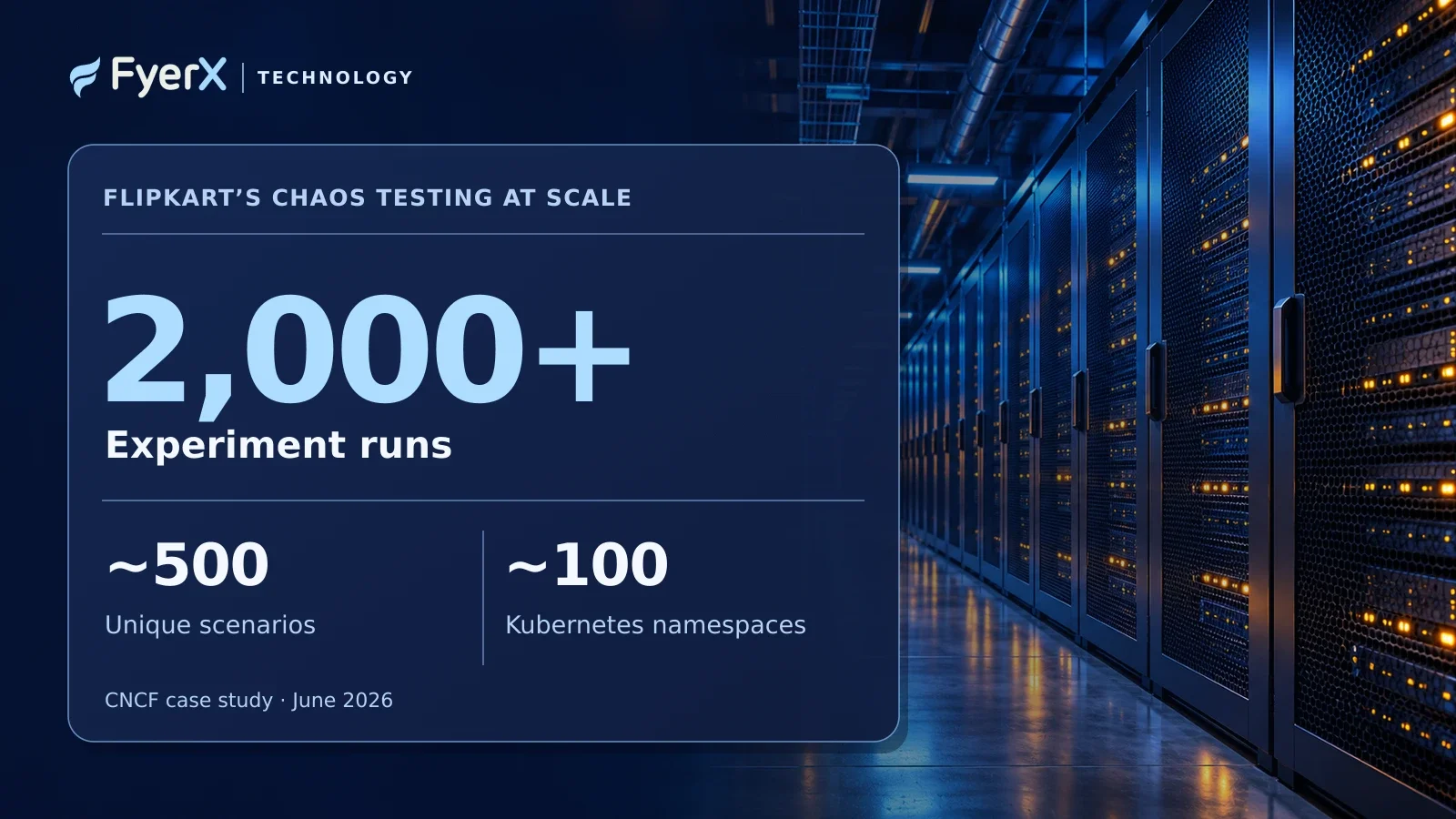
The June 2026 CNCF case study reported 2,000+ experiment runs across about 500 different scenarios, targeting around 100 Kubernetes namespaces. That difference between runs and scenarios matters. A team can repeat the same test after adjusting an alert, changing a deployment setting or fixing a recovery step, then check whether the result improves.
CNCF also reported that Flipkart identified and fixed at least six critical issues in alerting and deployment settings before Big Billion Days 2024. The cases show what the rehearsals uncovered. The October 2026 traffic figure shows what the teams were preparing to handle at sale scale. They come from different reporting periods.
The practical lesson applies to smaller businesses too. Pick one journey you can’t afford to lose during a launch, like accepting payments, confirming bookings or processing an order. Walk through what the customer sees when one dependency stops responding. Then ask who gets the alert, who owns the recovery and how the team will know the workflow is healthy again. If everyone gives a different answer, you’ve found something worth testing.
The real test is what the shopper experiences
When the sale opens, shoppers care about whether the offer is still there, whether the payment went through and whether the order is on its way. Flipkart’s drills give teams a way to practise answering those questions when a service fails. The sale may bring the biggest traffic of the year. The failure should feel familiar to the people responsible for fixing it.
FyerX Technology helps teams map the systems behind critical customer journeys through its Cloud & DevOps work. We use that map to plan how releases are tested, what teams monitor and who owns recovery when something fails.
Planning a sale, launch or cloud migration? Talk to FyerX Technology about getting your platform ready for peak traffic.
Looking for technology support?
Tell us what you need to build, improve, or manage.
Talk to FyerX Technology