

It’s Saturday, 8:12 p.m. You put a Hyderabadi biryani in your Swiggy cart. The app says 28 minutes. You haven’t paid yet. The kitchen hasn’t seen your order. A delivery partner may still be dropping off somebody else’s dinner.
Somehow, you already have a number precise enough to decide whether to order or heat up leftovers.
That 28 minutes is an example. The technology behind the estimate is real. Swiggy’s engineering team has explained how it predicts delivery time before checkout, updates that estimate as the order moves, and handles the chances of delay. The first clue is that your biryani and the person who will deliver it are already on two different schedules.
How Swiggy estimates delivery time before you order
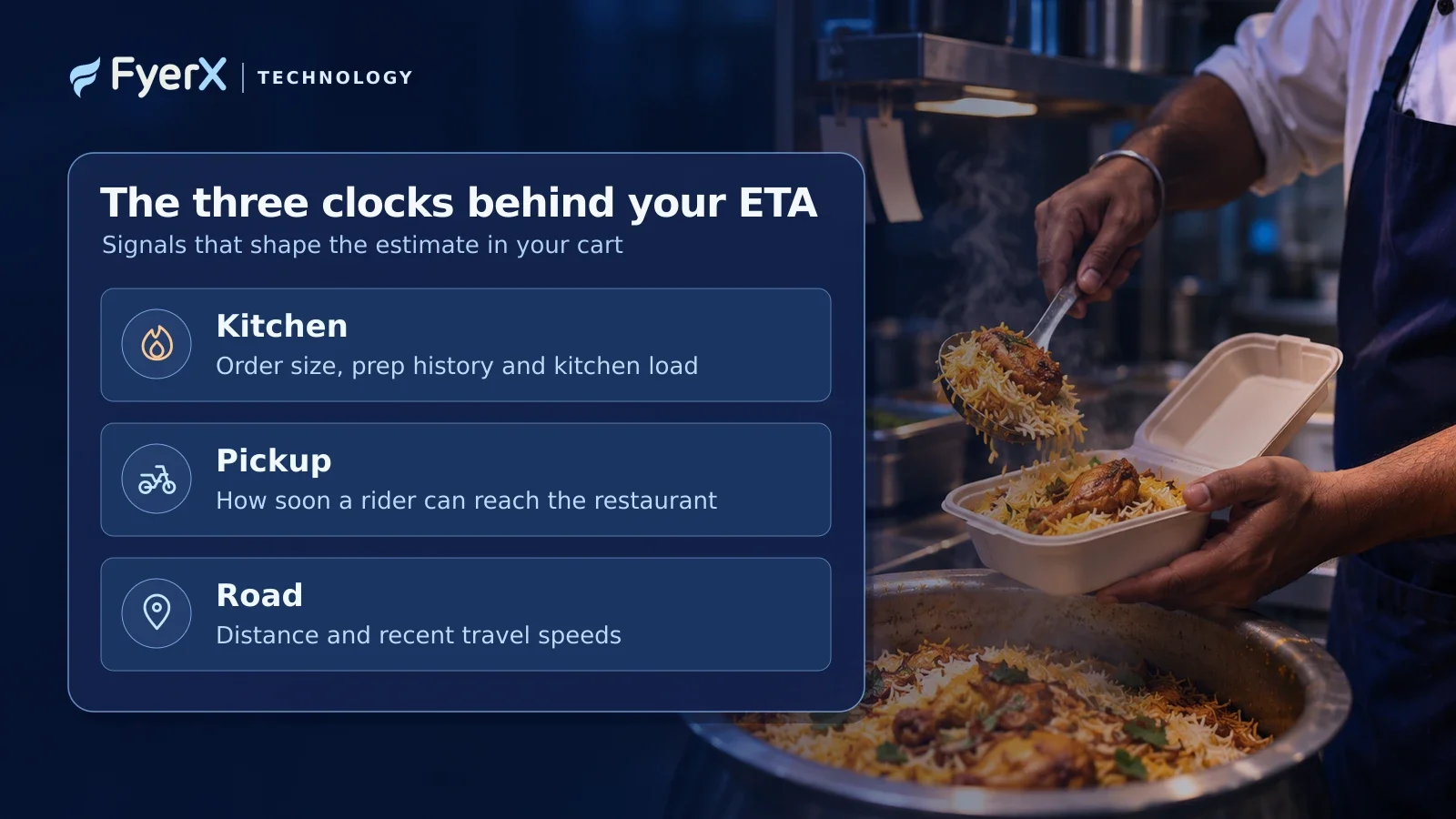
Once you’ve picked a restaurant and added items to your cart, Swiggy can take a first pass at how long the whole trip might take. Its published cart model describes using historical patterns alongside recent signals. A restaurant’s usual Saturday evening pace is useful. A sudden pile-up of orders at that restaurant tells you something different about tonight.
The kitchen clock. How long will your food take to prepare and pack? Swiggy’s write-up says its prep-time model considers the size and mix of items in your order, the restaurant’s previous prep times for those items, and recent orders placed and prepared. One biryani at a quiet kitchen and four biryanis at a packed kitchen can mean very different waits.
The pickup clock. How soon can a delivery partner be assigned and reach the restaurant? Swiggy looks at signals such as how many delivery partners are active relative to orders in the area, along with recent and historical pickup patterns. Someone may be close by but finishing another delivery. A restaurant that looks close on a map can still face a long wait for pickup.
The road clock. How long might the trip from the restaurant to your address take? Distance matters, and so do usual and recent travel speeds around the restaurant and drop-off location. A short ride through a crowded junction can take longer than a longer ride on a clear stretch.
These clocks can overlap. Say the kitchen needs 15 minutes and a delivery partner could reach it in 10. The rider’s trip to the restaurant can happen while the food is cooking. Swiggy says its assignment system tries to time arrival close to when the food will be ready, so the rider spends less time waiting and the meal spends less time sitting at the counter. Add a queue at the restaurant or a shortage of riders and that coordination gets harder.
Why your Swiggy ETA changes after checkout
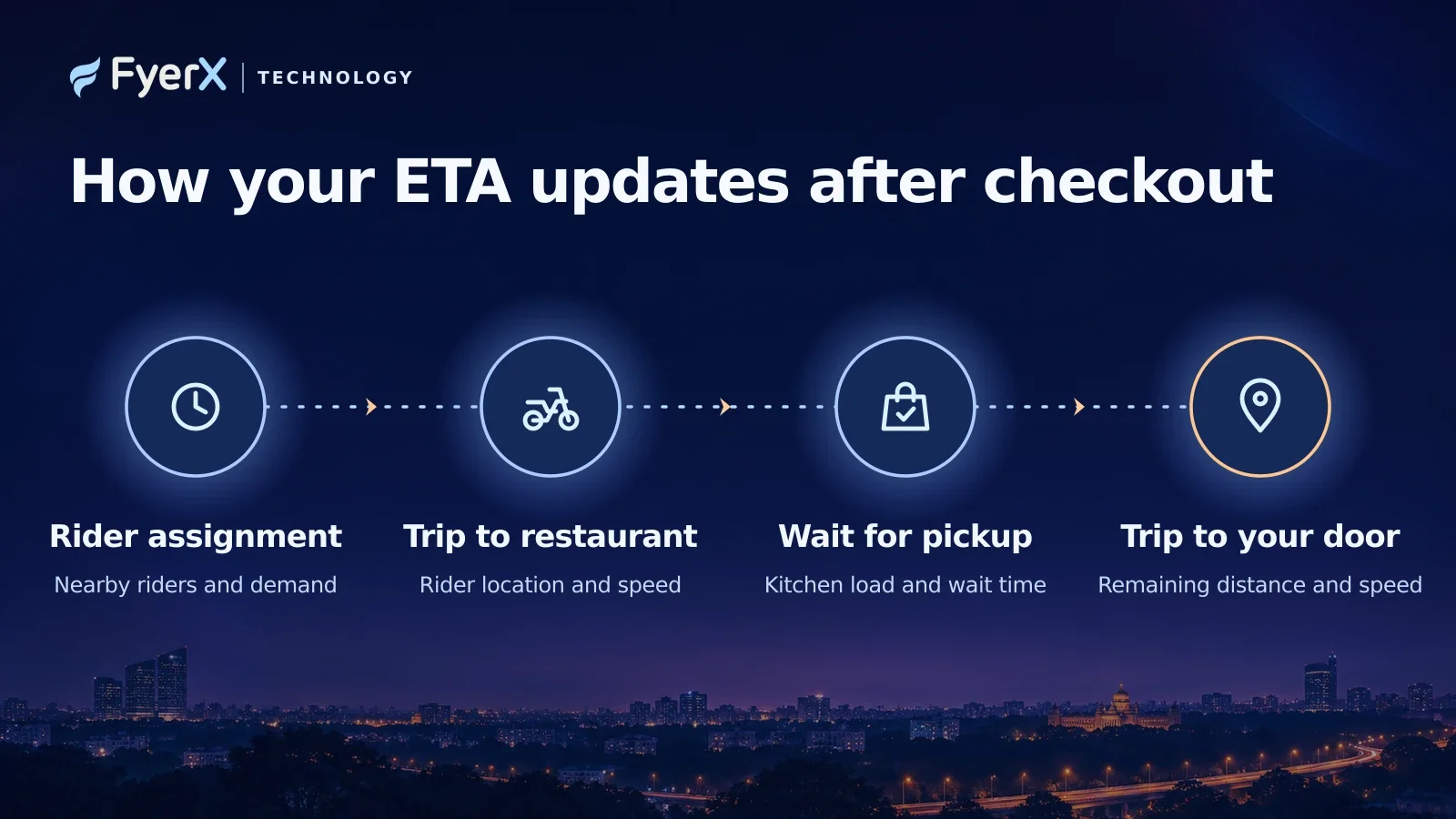
Now you tap Place order. The first prediction had to work with what the system knew at the cart. After checkout, the app can pick up more signals about your specific order. Swiggy’s published tracking architecture described four stages, each with a different reason your ETA might change.
Waiting for assignment. The system can update its estimate using information about riders around the restaurant and the number of orders competing for them.
Rider heading to the restaurant. Once a delivery partner is assigned, Swiggy has location updates and movement data it can use to refine the trip to the restaurant.
Rider waiting for pickup. If the rider has arrived and the biryani is still in the kitchen, the estimate can use factors such as the restaurant’s live order load and how much time has already been spent waiting.
Food on the way to you. After pickup, successive rider location updates help estimate speed and remaining distance. The app has a better view of the ride as it unfolds.
Imagine the app shows 28 minutes, two minutes pass, and the display goes up to 31. The estimate is answering, “How much time is left with the information we have now?” If the rider is assigned sooner than expected, it can move the other way. Swiggy’s engineers also measured inaccurate jumps in the displayed ETA. A number that swings sharply and repeatedly is hard to plan around, even if its average error looks acceptable.
There’s also a data problem behind that tracking screen. Swiggy has described using Confluent Kafka, a platform for streaming events, to support order tracking and delivery predictions. Think of an assignment or pickup update as an event other services can react to. The delivery model needs fresh inputs because an accurate prediction based on the rider’s old location can quickly become irrelevant. Streaming delivers those signals to the systems that need them. The model uses the signals to estimate what happens next.
Why Swiggy’s newer delivery model predicts a range of possibilities
Two orders can have a similar expected delivery time with very different chances of being late. Picture one on a clear weekday afternoon and another on a rainy Saturday night. The second order has more ways to slip. If both estimates come from a model that only returns one number, it’s harder for the team to tell those cases apart.
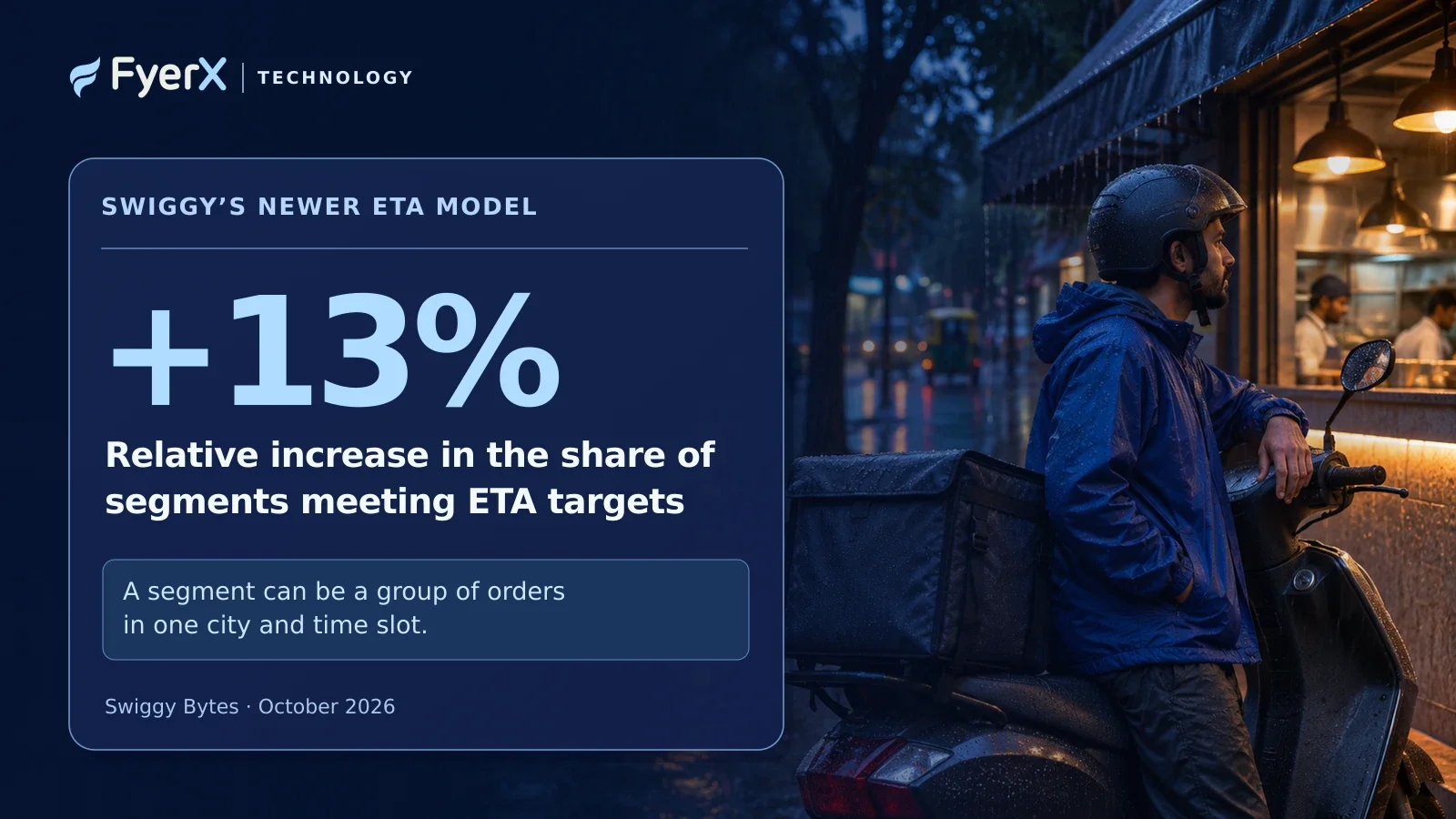
In October 2026, Swiggy described an approach that estimates a distribution of possible delivery times for each order. Think of it as a way to answer both “What time would be typical?” and “How much could this vary?” The system can use that spread to choose a customer-facing estimate based on the target for a particular group of orders, such as a city at a given time of day. Swiggy said it deployed the approach nationwide for its customer-facing ETA.
Swiggy reported a 13% relative increase in the share of segments meeting their ETA compliance targets. The company measures compliance by checking whether orders arrive within the estimated time plus a buffer. The result is about more local groups of orders hitting their target. It gives the team a way to see an improvement that a national average could hide.
There was a clever detail in how Swiggy tested the model. Changing the time shown to some customers can change which restaurants they order from. That affects the same pool of riders everybody else relies on. Swiggy says it first ran the new model in shadow mode. It made predictions on live orders while customers continued seeing the existing estimates. The team could compare the new predictions with what actually happened without changing the times people saw while deciding what to order.
A delivery time people can plan around
The next time Swiggy gives you 28 minutes, picture the restaurant pass, a rider travelling to meet the food, and a junction that might slow the last stretch. Your screen shows one number because that’s what helps you decide whether to order. The useful engineering is in knowing which signals matter, updating the estimate when they change, and checking whether it works on a rainy Saturday as well as a quiet afternoon.
By the time you hear the doorbell, the kitchen and the rider have both done their part. The model’s job was to give you a time you could plan dinner around.
Building a product that depends on live operational data? Explore FyerX Technology’s Data Foundation for Applied AI.
Looking for technology support?
Tell us what you need to build, improve, or manage.
Talk to FyerX Technology