
The bowler is halfway through his run-up when your WhatsApp group explodes. Someone has already typed “SIX!” On your phone, the ball is still in his hand. You and your friend are watching the same match live. Your screens are a few seconds apart.
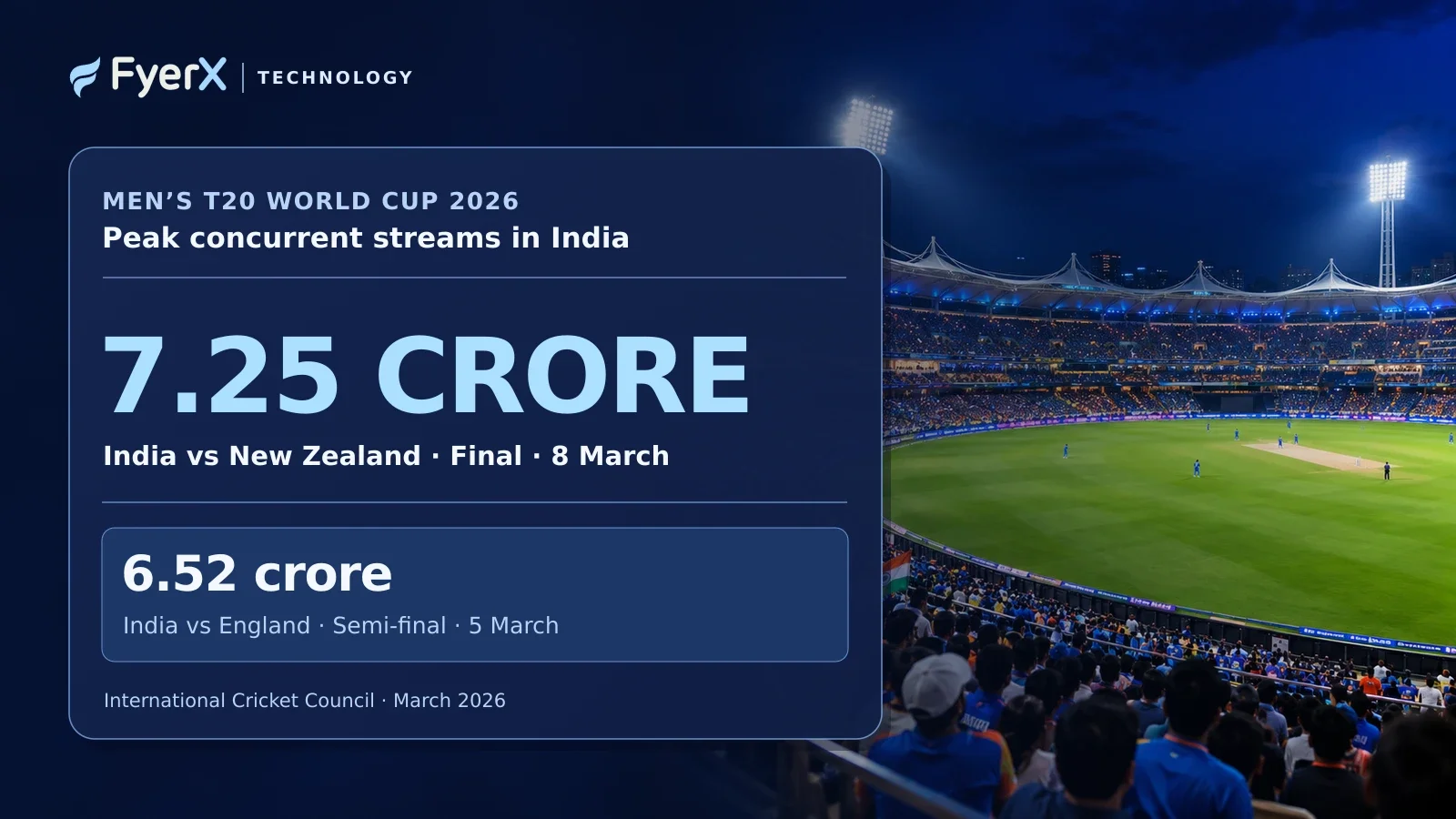
On 8 March 2026, the ICC Men’s T20 World Cup final between India and New Zealand reached 7.25 crore simultaneous streams on JioHotstar. The International Cricket Council confirmed the peak was in India. Three days earlier, the India–England semi-final had peaked at 6.52 crore. Peak concurrency measures how many streams are active at one moment. A family watching together on one TV shares one stream.
The hard part was sending live video to that many screens across different internet connections, while millions of fans were watching for the same ball. Here’s where the seconds go, and what JioHotstar engineers do to keep the video moving.
How a cricket ball travels from the stadium to your screen
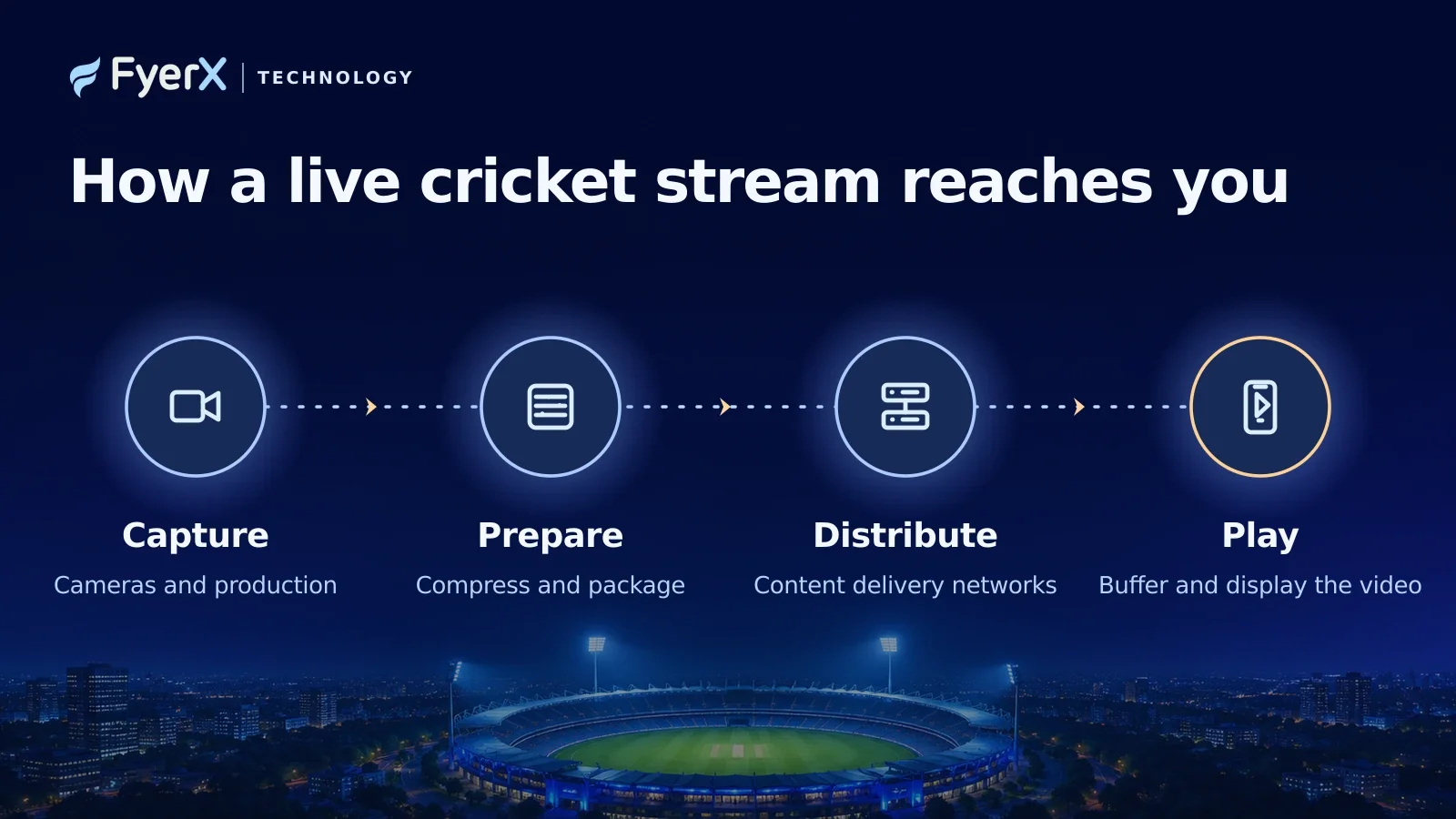
Think about the journey of one delivery, from the bowler releasing the ball to you seeing it on your phone.
Capture the action. Cameras at the ground send their feeds to the production team. The live broadcast combines selected camera shots with audio, commentary and graphics.
Prepare the video. Streaming systems compress the feed and create versions that need different amounts of data. The video is packaged into small pieces that an app can request while the match is still happening.
Distribute it. A content delivery network, or CDN, serves those pieces from distributed servers. That spreads the delivery work and gives viewers paths to the video through different networks.
Play it. The app downloads the pieces, keeps some video ready in reserve, and plays them in order. That small reserve gives the app a cushion if your connection slows down.
This is a simplified streaming path. JioHotstar’s engineering team has described preparing different video variants for devices and delivery networks. A phone on mobile data and a connected TV on fibre can both play the same six, with different versions of the video and different delays.
Why JioHotstar uses more than one delivery network
Imagine you’re watching in Chennai on a local broadband provider, while your friend is on 5G in Delhi. The fastest route to serve the video to your friend may be a poor choice for you. Conditions can vary even for customers of the same provider in different cities.
JioHotstar’s March 2026 engineering write-up described the bandwidth demand for a major live event as being on the order of 60–80 terabits per second. Serving that volume means spreading the work across CDNs. Each network has finite capacity, so sending every new viewer to the CDN performing best at that moment can overload it.
To manage that, JioHotstar built a Quality of Service Routing Manager. It looks at how the video is performing for specific groups of viewers, using details such as city and internet provider. If people on one provider in one city are having problems with a particular delivery network, a nationwide average can hide the issue. A local view gives the team a chance to shift some of that traffic to another CDN that can serve those viewers.
What JioHotstar watches when the stream starts to struggle
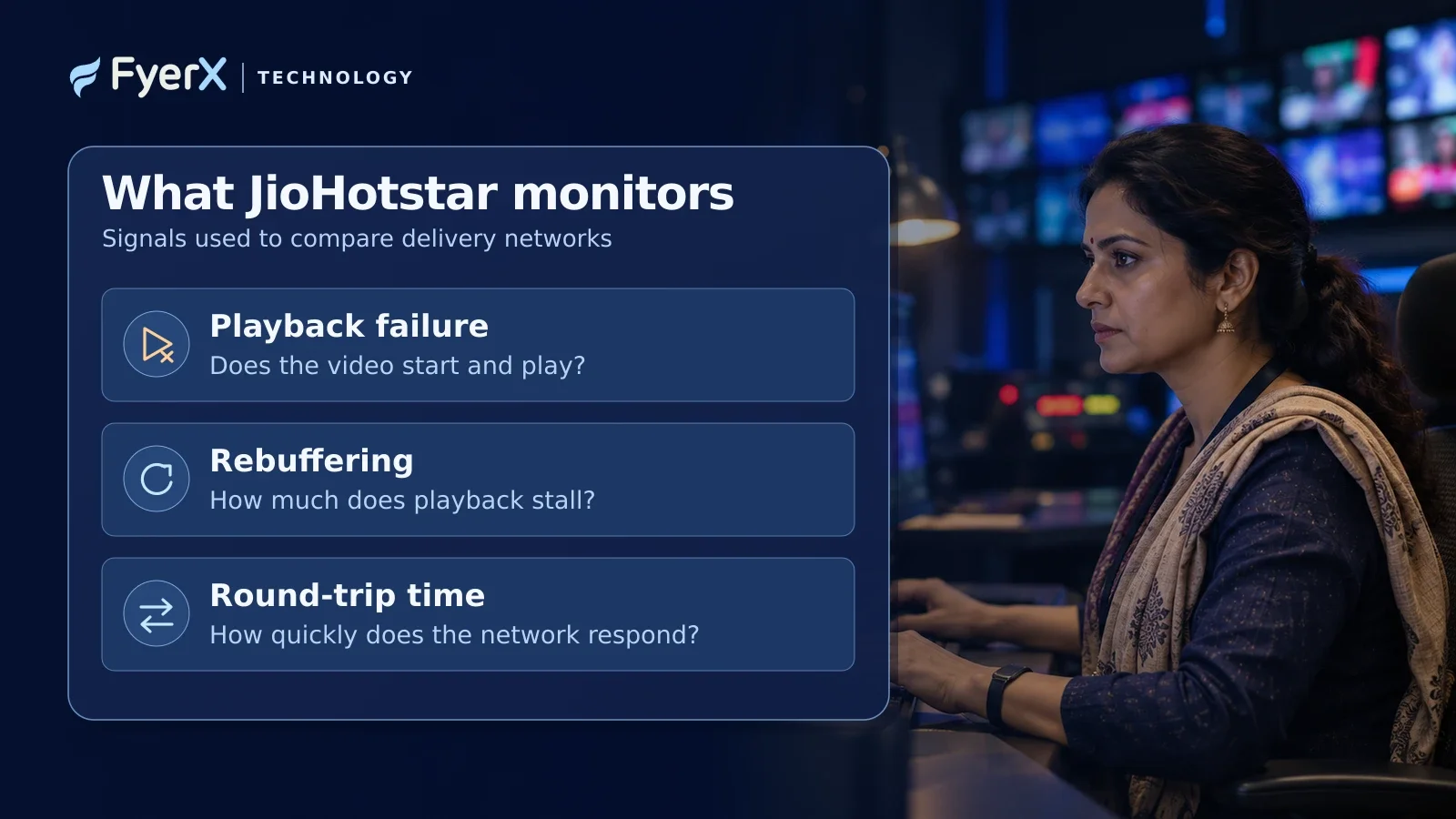
The routing manager gets data from playback on viewers’ devices. JioHotstar’s engineers describe three measures that help them compare the delivery networks available to each group.
Playback failure rate. How often does the video fail to start or play successfully? The team gives this measure the greatest weight in its routing score.
Rebuffering. Once the video is playing, how often or how much does it stall while the app waits for more data?
Round-trip time. How long does a signal take to reach the network endpoint and come back? A higher time can help engineers identify a slow path.
Picture a pocket of viewers whose playback keeps stalling. The system can adjust how much traffic it sends to different CDNs for that group. It also checks available capacity and limits how much traffic can shift at once. That way, a brief spike in buffering has less chance of sending a crowd of viewers to a network that is already busy.
In an experiment during a T20 match, JioHotstar’s engineers reported an 11% improvement in playback failure rate for the group that received the new routing approach, alongside 2% improvements in rebuffering and round-trip latency. These are results from that routing trial. The World Cup final’s 7.25 crore figure measures peak audience load.
Why your friend can see the six before you do
Live video needs time to travel through production, compression, delivery and playback. The app also has a trade-off to make. Keeping more video ready to play can help it get through a short network slowdown. It can also leave your screen a little further behind the action.
There’s a second trade-off inside the player. With adaptive bitrate streaming, the app can pick a lighter version of the same video as your connection gets slower. A quick drop in picture quality can be what keeps the ball moving on screen. If your connection recovers, the player can move up to a sharper version when conditions allow. JioStar’s CTO described this balance in a November 2026 interview with Mint. A stream has to stay watchable while getting as close as practical to live.
JioHotstar also tests playback on actual devices. Its engineering team described how a video feed can look healthy to a server while a smart TV is stuck buffering. Its automated checks inspect the feed and test what viewers would experience on devices. That’s how a team can catch a problem affecting a particular feed or screen while other fans carry on watching.
What happens when everyone taps Play at once?
A match can also put pressure on services that deal with sign-ins, subscriptions and other app requests. Imagine the video is ready to stream, but the app is waiting to check your access. From your sofa, that still looks like a match you can’t watch.
At KubeCon India 2026, a JioStar engineering leader described how JioHotstar uses Kubernetes and OpenTelemetry in its cloud infrastructure. Kubernetes helps teams run and scale services. OpenTelemetry helps collect signals about how those services behave, such as which part of a request took the most time. That gives the operations team another way to work out where a delay began, alongside the data it gets from viewers’ video players.
What 7.25 crore streams really asks of a platform
The next time your group chat spoils a six, consider the choices your player made to get the ball onto your screen. Which version of the video could your phone handle? Which delivery network had room? How much could the app keep ready in case the signal dipped?
For JioHotstar, the work behind that one ball is repeated across crores of sessions. The real job is to notice when one group of viewers is struggling, act while the match is still on, and keep checking whether the picture on their screens has actually improved.
FyerX Technology brings that same focus on real customer experience to its Cloud & DevOps work. We help teams identify the services a critical journey depends on, decide what to monitor, and plan how to respond when a launch or traffic spike puts those services under pressure.
Preparing for a high-traffic launch or live event? Talk to FyerX Technology about making your platform easier to monitor and ready to scale.
Looking for technology support?
Tell us what you need to build, improve, or manage.
Talk to FyerX Technology